
EcoBilge News


EcoBilge Participates in Rostock Climate Action Day
On 26 September 2026, the EcoBilge project took part in Klimaaktionstag (Climate Action Day) in Rostock, represented by Dr. Josephine Schaumburg, project coordinator at the University of Rostock.
During the event, Dr. Schaumburg also served as an ambassador for EU-CONEXUS, a European university alliance dedicated to research, innovation and sustainable development.
Her participation brought together two initiatives addressing contemporary environmental challenges, highlighting the importance of scientific research and international collaboration in advancing sustainability.
EcoBilge Participates in the International SOWOS 2026 Conference
On 22–23 September 2026, Hamburg, Germany, hosted the 12th edition of SOWOS (International Symposium on Treatment of Wastewater and Waste on Ships), an international conference addressing environmental challenges associated with wastewater and waste management on board ships.
The event brought together representatives from the maritime industry, research institutions, regulatory authorities and environmental technology specialists to discuss treatment solutions, monitoring and compliance with international regulations aimed at protecting water resources.
Key topics included oily bilge water treatment, ballast water management and the implementation of international regulations, including the MARPOL Convention and IMO Resolution MEPC.107(49). These issues are directly related to the objectives of the EcoBilge project.
SOWOS 2026 provided a forum for discussing the relationship between technological innovation, regulatory requirements and the protection of aquatic ecosystems — central themes of the interdisciplinary research conducted within EcoBilge.


EcoBilge auf der Shipbuilding, Machinery and Maritime Technology Trade Fair
EcoBilge was represented at the SMM (Shipbuilding, Machinery and Maritime Technology Trade Fair) in cooperation with the DBU.
EcoBilge Presents Research and Joins Baltic Sea Discussion at Science@Sail
On 7–8 August 2026, the EcoBilge project participated in Science@Sail in Rostock, contributing to science communication and discussions on environmental challenges related to shipping and the protection of aquatic ecosystems.
On the first day, Veith Hahner introduced EcoBilge to a non-specialist audience, explaining the project's structure and the initiatives undertaken by the University of Rostock to promote environmentally sustainable shipping.
The following day, Dr. Josephine Schaumburg, EcoBilge project coordinator, took part in a panel discussion titled "The Baltic Sea – A Habitat, a Place of Longing, a Cause for Concern?" The discussion also featured Dr. Kristina Barz, Dr. Michael Naumann and Ramon Gerwien, addressing key issues affecting the Baltic Sea region.
EcoBilge's participation in Science@Sail helped connect university research with the wider public and foster dialogue on the environmental challenges facing the maritime sector.

A visit to (IN)VISIBLE in La Rochelle
On June 27, 2026, one of the working students from EcoBilge was in La Rochelle as part of the EU-Connexus initiative and took the opportunity to visit the exhibition "(IN)VISIBLE" by Ms. Sionnet.
Together with the artist and several deaf individuals from La Rochelle, they explored and admired the exhibition.
The focus on inclusion was palpable from the very beginning. Visitors were able to experience what it is like to lack one of the senses—and how, in turn, the remaining senses become heightened.
The artworks were treated with a special printing technique, ensuring that the underlying message only becomes apparent when viewed from a specific angle.
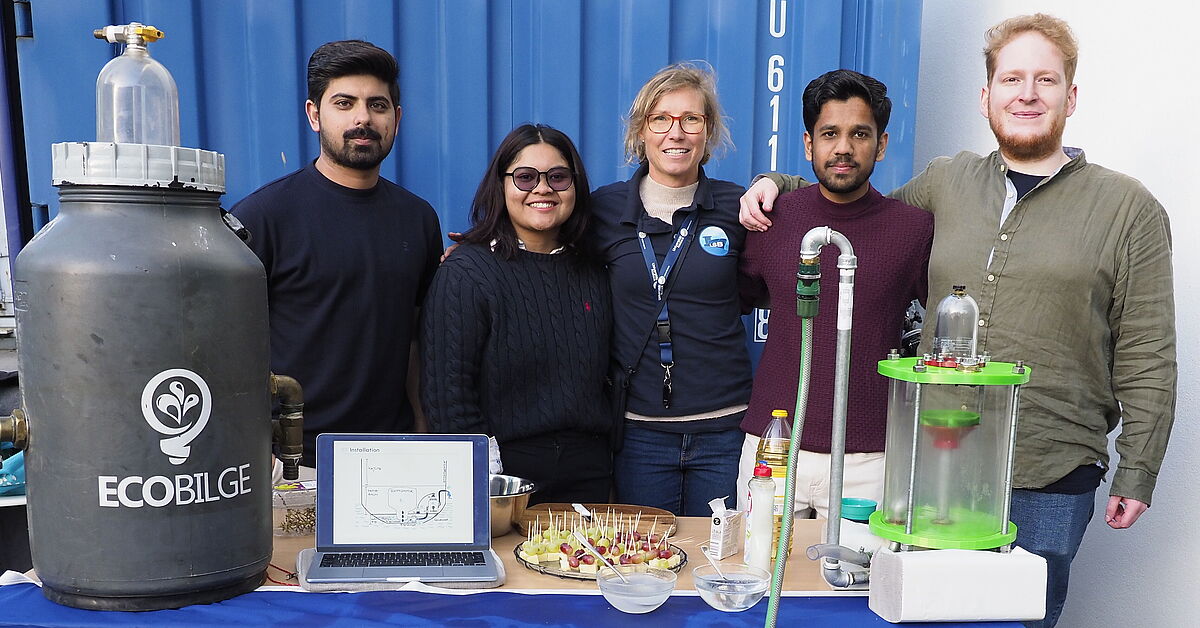
EcoBilge bei der Langen Nacht der Wissenschaft
On April 23, 2026, EcoBilge took part in the Long Night of the Sciences.
On the grounds of the Faculty of Mechanical Engineering, we had the pleasure of meeting people of all ages—from primary school children to senior citizens.
Through a playful experiment, our youngest visitors were able to explore why oil slicks in our oceans are often so difficult to detect.
Adults, too, found plenty to engage with, learning more about the issue of bilge oil pollution.
It was a successful event for researchers—both young and old—and for anyone with an interest in science.