
High-Resolution 3D Printer for Model Propellers (DruckProp)
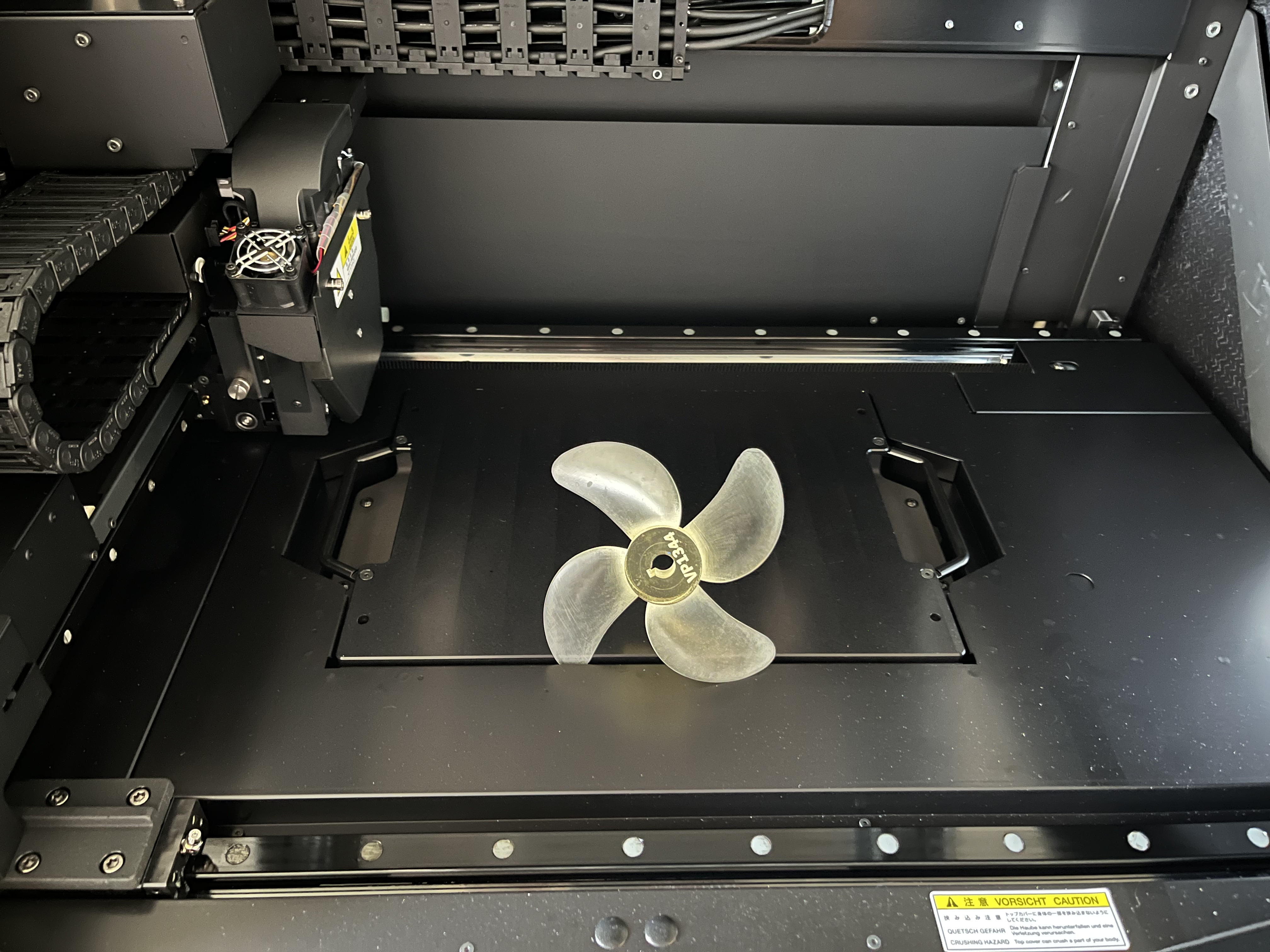
Description: The Chair of Ship Design operates a high-resolution 3D printer, the Keyence AGILISTA-3200W. The printer uses inkjet technology: much like an office inkjet printer, it deposits tiny droplets of resin through nozzles and cures them with UV light. Layer thicknesses of 0.015 mm allow fine geometric features to be reproduced and give a smooth surface on all sides.
During printing, overhangs are supported by a water-soluble support material. After printing it is dissolved in water and leaves no marks. Compared with other UV-curing resins, the standard material (AR-M2) stands out for its toughness and low water absorption (≤ 0.35 %). This is particularly important because the propellers are intended for use under water.
Application: The printer is mainly used to produce model propellers for tests on the chair's propeller dynamometer. Until now, such models have been laboriously milled from brass or aluminum and finished by hand, which is time-consuming and expensive. With the 3D printer, a new propeller design becomes a test-ready model within hours. This gives the chair the complete process chain in-house: computer design → 3D printing → model testing. Far more propeller variants can be tested, including bold ideas that would previously not have been built for cost reasons.
Aims:
- fast, cost-effective production of precise model propellers for open-water tests
- development of more efficient and quieter ship propellers to help reduce fuel consumption and CO₂ emissions
- testing novel propeller shapes that can only be manufactured by 3D printing
- propeller tests beyond the operating point (four-quadrant tests, e.g. for crash-stop manoeuvres)
- models of current turbines and propulsors for underwater vehicles
- low-threshold access to model testing for companies in the maritime industry in Mecklenburg-Vorpommern
- teaching: students follow the full path from design through printing to testing
Interested in using the printer?
The printer is not only of interest for propellers but also for other components that require particularly fine structures or benefit from the washable support material (e.g. fine channels inside a structure). If you are interested, please get in touch and we will clarify feasibility, costs and procedure together.
Contact:
Iven Topp
Phone: +49 (0) 381 498 9273
Mail: iven.topp(a)uni-rostock.de
Funding: The device is funded by the European Regional Development Fund of the European Union (EFRE for german Europäischen Fonds für regionale Entwicklung) as part of the 2021–2027 EFRE program in Mecklenburg-Vorpommern.


All information at a glance:
- Purpose: production of model propellers and precise test parts
- Manufacturer: Keyence
- Model: AGILISTA-3200W
- Process: inkjet resin printing (UV-curing), water-soluble support material
- Build Volume: 291 x 210 x 200 mm
- Min. Wall thickness: ca. 0,2 mm